  1. Categories/

Cc

2008


econophysics and community currency

I’ve recently been introduced to the field of econophysics and I’ve read an interesting the review paper on the field. My thoughts on this paper is that it’s very good news for the community currency movement, if understood properly. For a long time when talking about cc, I’ve been using the little thought experiment of asking people to imaging the Buddha, Jesus and Mother Theresa sitting down to play monopoly and to see if the game will have a different outcome. The answer is obviously no, not if they play by the rules. It doesn’t matter how good or evil you are, the rules of monopoly simply require that all the cash end up in one player’s hands, i.e 100% inequity. The econophysics work on the Statistical Mechanics modeling of money takes this intuitive analogy and “proves” quite definitively the fundamental inequity of our current system if you assume that the rules of the game are that money behaves like energy. The good news for community currency arises out of the basic flaw of the paper which is it seems to imply that money is natural system, rather than a created one. If money were an inevitable natural system, then the paper could be seen as an justification of that structural inequity. But since it is a created one, rather it’s an explanation of the the inequity, and thus can point us very clearly in directions of how the monetary system should instead be re-designed. What are those directions? Well, we see in the paper the very careful arguments to show how money is conserved. This is crucial to the model because in the model money is energy, and statistical mechanics is built on the law of the conservation of energy. But more importantly their model is about statistical equilibrium of energy states in closed systems. So this gives us a clear indication of where to go: change the monetary paradigm to one where the fundamental model is based on non-equilibrium state energy systemics. Well, we know what non-equilibrium state energy systems are, they are living systems. In living systems what matters fundamentally is not how much energy is accumulated but rather, whether energy can be made to flow in particular complex patterns that themselves are self-sustaining. Even more crucially, life is not about what happens if energy is allowed to dissipate to equilibrium. The name for that process is death! So I think we could even argue that that the modeling they have done is of the death of an economy! Life is not about accumulation of the energy itself, but instead it is about the accumulation of the complex patterns of energy flows. The word for a such patterns is “ecosystem”. In their model money is seen as energy, or the capacity to do work. This actually makes sense for an early stage in the evolution of money. When the main issue is the scarcity of the capacity to get work done, then finding ways to accumulate it is key, and building an economic structure to generate that accumulation makes sense. We now live in a world where our capacity to do work is not at all scarce, it’s over abundant. The big problem is the waste human capacity (think of the structural unemployment) and also the squandering of all that massive capacity in ways that are blatantly destructive (military expenditures) or systemically destructive (climate change). So our task is now to re-gear the fundamental system to not simply accumulate of the capacity to do work, but mostly to accumulate particular patterns of that capacity that are what we call “healthy”. So, how do we do that!? I use a completely different model for money that I think fits the bill, namely that money is a form of language, or more precisely a writing system that encodes information about wealth events. This model transcends and includes the model of money as energy, because in its simplest form, the rules of the writing system can be made to follow the rules of conservation of energy. What I have been calling for and working on with open money (as well as collaborting with Art Brock on his OS-Earth platform) is a meta-currency system that is precisely about making it easy to create these many different writing system (currencies) and their rule-sets, or another way to put that, that precisely enables a the creation of pattern sets for economic flows.

mexico

·1 min

I’m in mexico, and it’s the start of the third day of the open money intensive.  This is an incredible experience of the expansion of the open money vision that’s been in gestation for so long and is now being  birthed.  More soon!

2007


why i am working on open money

Recently I’ve had opportunity to reflect on why I’m particularly dedicated to the open money path out of all the many different community currency paths.

I offer it here not in the spirit of saying open money is better than other approaches, but rather just to share my understanding and what motivates me to work where I know I am best suited to contribute.

More on language and wealth acknowledgment

·2 mins

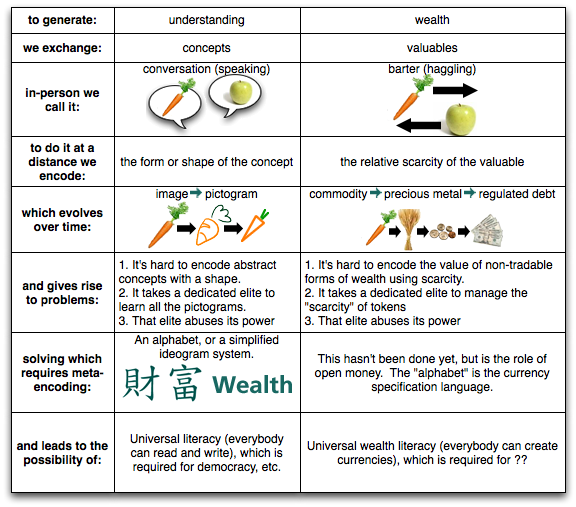
In a discussion today with Jean-François about the content of my previous post, he described another very important way of thinking about the evolution of writing from pictographs to alphabets and ideograms. Namely that the step taken was from a system in which representations could be created, to a system in which information can be created. Likewise our current wealth acknowledgment systems actually represent wealth directly. A direct consequence of this is that money can be stolen. Writing, however creates information. Information intrinsically can’t be stolen (you have to set up complicated legal systems to shoe-horn information into being steal-able). Open money embodies the shift to a wealth acknowledgment system that allows us to move beyond representing wealth, into building information about wealth.

the cost of lies

·2 mins

Today it occurs to me that one way of describing inflation is that it is a tax on falsehood. Most of the taxes we pay are explicitly levied in some way or another. Inflation is the implicit tax that we pay through the structure of the monetary system itself, because of the way money is issued. I don’t want to dwell on that too much as others have; see: wikipedia, Ron Paul on the right, and Tom Greco on the left.

Language, Money and Wealth Acknowledgment

·8 mins

David Abram, in his book The Spell of the Sensuous, describes the history of written language and its evolution from pictographic directly representational symbolic system to an abstract phonemic system. He describes the incredible intellectual leap taken by some scribe who realized that the symbol doesn’t actually need to have ANY visual resemblance to the thing it represents. Apparently this evolutionary step came as a joke, as a pun. To describe this, the example Abram imagines is putting the image of a bee together with that of a leaf, making the word bee-leaf = belief. There is simply no pictorial representation of the abstract notion of a belief, but the pun simultaneously allows this representation and brings us to the first step of writing words phonemically. There are historical example of this in pictographic writing systems, and even in the first truly phonemic script of the semitic scribes, letters are often visually reminiscent of the word that contains that letter. For example our letter “A” comes from the aleph, which is drawn like our letter “A” turned upside-down and which looks like the head of an ox. The semitic word for ox began with the sound that the letter represented.

the "elevator-pitch" for community currencies

There’s a skype chat I’m on that discusses community currencies, that recently was trying to find “the ultimate elevator pitch” for community currencies. This is a very reasonable request as all of us working in this area are frequently asked to describe what we are up to succinctly. Here’s my post to that chat in response to this request:

confucianism, standards, and culture

·1 min

In a previous post, I talked about how there are two different kinds of trust, and how important that is to understanding what needs to happen in the currency world. Here is a fantastic essay on confucianism technical standards and culture, which gets to the same essential pattern but in a different arena. The essay includes the following quote from Confucious’ Analects:

2006


community currency and trust

·2 mins

When ever I introduce people to the idea of community currencies, I have experienced that the question of trust comes up again and again. This is reasonable, but I’m quite convinced that the breadth and depth of what trust is, is very poorly understood. Trust seems to be a word that, in the case of money, is hiding at least two forms of something that are actually quite disparate. I think this is because experientially, these forms of trust feel the same, but they arise from entirely separate circumstances. Some examples to get at this:

Yahoo gets into the community currency game

·2 mins

It looks like yahoo is getting into the community currency game with Yootles. A quick read of the their FAQ indicates a highly “economics” based approach. Also I don’t see an indication of the meta understanding that what’s necessary is to provide a playing field for people to create currencies, rather than just Yet Another Currency (YAC).

Currency "Equity" (Yet another community currency metaphor)

·2 mins

“Don’t worry, it’s a rental.” That’s what we say when we drive that Hertz car smack through a pot hole. The difference between how people keep up rented appartments and owned homes is a standard trope in our culture. We understand that people feel and behave differently about things that they own. The same must be true for currency. If we create our own currency, instead of rent it from a unknown source, we will treat it differently. In fact, we will probably do a lot of things differently, just because it’s ours and we own it. Probably most importantly, we can begin to thing about the “value” of the currency in a different way. We clearly understand that the value of a home is not encoded simply in the number of dollars we’ll get from it when we sell it. It’s true value is in the home’s utility to us, here and now. Oddly, the same is true of a currency. Selling a currency on an exchange market is like selling a house. It shows one kind of value that it has; it’s value to people who are comparing the overal value of two separate currencies (just like someone about to by a house may be comparing the overall “value” of two houses). But a currency, like a house, has the utility value of those who use it, which is of substantially different form than its exchange value. There are other things that might be different if we own our currency instead of rent it. Our relationship with debt might be different. For one thing, we would come to a deeper understanding of the connection between debt and money, and thereby be more healthy about it. The monetary experience is by its fundamental nature is the combination of debt and credit. The money I hold in my pocket is positive side of the ledger that elsewhere is written down as a negative number: a.k.a debt. It is not possible to have money without debt. If we owned our own money, the question of what kind and what amount of debt we want to have would become much more crucial to answer well and wisely.

another currency metaphor

·1 min

In my on-going quest for good metaphors and ways of thinking about the community/multi-currency world, an excellent metaphor came to me that is useful when talking about all this with programmers:

Phronesis and the Internet: the Process Revolution

I learned about the Aristotelean intellectual virtue of phronesis along with the related term episteme a few years back from Kathryn Montgomery in discussions about her book How Doctors Think. Episteme is the scientific rationality we are all quite familiar with. Phronesis is usually translated “practical wisdom” and is the kind of rational skill doctors and entrepreneurs have that is based on experiential knowledge and provides the ability to take the best action in particular circumstances. We are much less likely to have thought of this as a separate kind of rational capacity. These terms came up again recently for me in the context of a collective intelligence discussion, which really set my mind going and has led me to some propositions and a conjecture:

Viral Communications

·1 min

I’ve just read Andrew Lippman and David Reed’s paper on Viral Communications. It’s quite insightful. Two things:

  1. I’ve said it before, but “Intelligence at the Leaves” for currency is what the open money project is all about. Currency is the centralized communication tool that needs to undergo the same process that Lippman and Reed describe in the paper, for all the same reasons. “In the end, viral communications transforms communication from something you buy to something you do. Independence of operation allows communications services to be separated from traditional service providers.” Substitute currency for communication.
  2. On a more speculative note: maybe the reason why SETI has not been successful so far, is that intelligent species move very quickly to low power Tim Shepard style scalable radio! So our current high power RF output is very naturally a short lived (i.e. 200 year) stage in technological development, that lasts only long enough for us to realize that we are better served with a very different pattern of radio usage, which is not detectable at interstellar distances. Assuming this is true, I’d gues that the probablity of catching another intelligence in the same 200 year window is not very high.

[tags]viral communication,viral,SETI,open money,currency,money,scalable radio,David Reed,Andrew Lippman,Eric Harris-Braun,p2p[/tags]